Episode 8

The Map of Cooling Destiny

A funny U.S. map shows where swamp coolers shine, struggle, or should stay home. Swamp Cooler Boy learns that geography is not decoration — geography is destiny.

The map appears

Dry Air Sensei unrolls the most important picture in the series.

The crew gathers around a giant U.S. map painted on a desert billboard. Swamp Cooler Boy is holding a marker. Solar Fan Kid is holding the legend. Desert Grandma is holding iced tea and the truth.

“Today,” says Dry Air Sensei, “we stop guessing. We look at the country and ask the only question that matters: where does the air help you evaporate water?”

Humidity Monster peeks in from the Southeast corner and yells, “Please ignore the map. Maps are rude.”

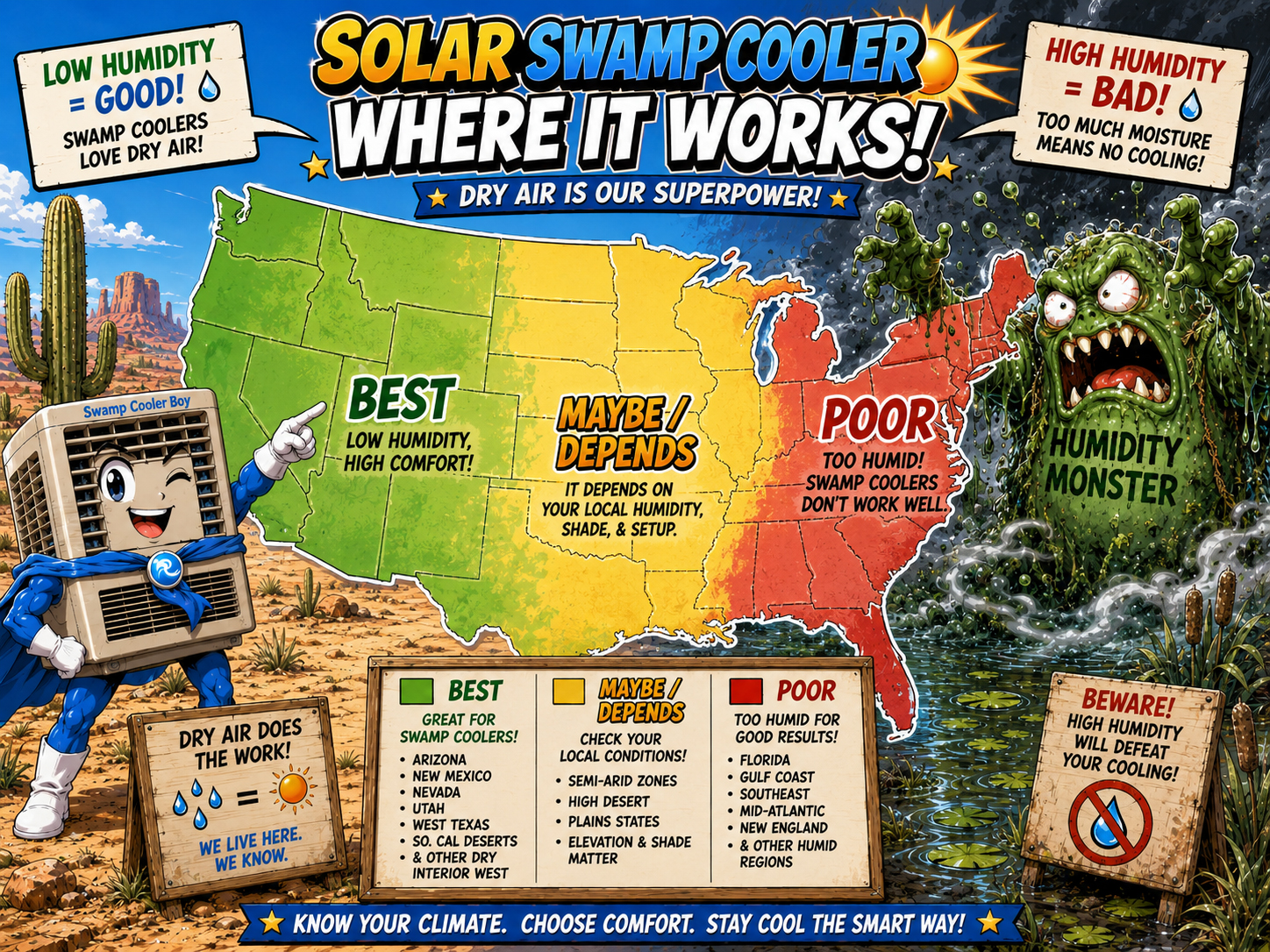
Funny U.S. map showing where swamp coolers shine, struggle, or should stay home.

Scene 1

The green zone: where Swamp Cooler Boy shines.

Swamp Cooler Boy points to the dry interior West. Arizona, New Mexico, Nevada, Utah, inland deserts, high desert areas, and dry climate pockets begin to glow.

Swamp Cooler Boy: “These places feel like home. Hot sun, dry air, and room for evaporation.”
Dry Air Sensei: “Correct. Low humidity gives the water pad a job.”
Desert Grandma: “Out here, we know the drill: dry air, wet pad, open windows, clean pan.”
Solar Fan Kid: “And the sunny hours can line up with fan and pump power. Nice.”

Scene 2

The yellow zone: where the answer is “maybe.”

The middle of the map flickers yellow. Swamp Cooler Boy gets excited, but Dry Air Sensei raises one eyebrow so dramatically that the wind stops.

Swamp Cooler Boy: “Yellow means I can go, right?”
Dry Air Sensei: “Yellow means ask questions. Season, elevation, daily humidity, shade, building design, and expectations matter.”
Desert Grandma: “A maybe zone is not a yes zone. It is a ‘check the real weather’ zone.”
Solar Fan Kid: “So no guessing from a brochure?”
Desert Grandma: “Especially not from a brochure.”

Scene 3

The red zone: where Humidity Monster dances.

Florida, the Gulf Coast, the humid Southeast, and sticky coastal regions flare red. Humidity Monster bursts through the map wearing sunglasses and holding a victory smoothie.

Humidity Monster: “Welcome to my red zone. The air is wet, the towels are damp, and evaporation is tired.”
Swamp Cooler Boy: “So I should not charge into every humid house just because someone says ‘cooler’?”
Dry Air Sensei: “Correct. The wrong climate makes the right machine look foolish.”
Desert Grandma: “Let Compressor Dragon handle sticky-air work.”

Scene 4

The crew learns the map is only the beginning.

Swamp Cooler Boy wants to frame the map and call the case closed. Desert Grandma taps the legend and reminds everyone that real homes need real local thinking.

Desert Grandma: “The map is a guide, not a permit, not a design, and not a guarantee.”
Dry Air Sensei: “Local humidity, equipment sizing, water quality, pad condition, airflow, and maintenance still matter.”
Swamp Cooler Boy: “So geography tells me where to start. Local conditions tell me whether to proceed.”
Solar Fan Kid: “And solar helps power the equipment only after the climate question is answered.”
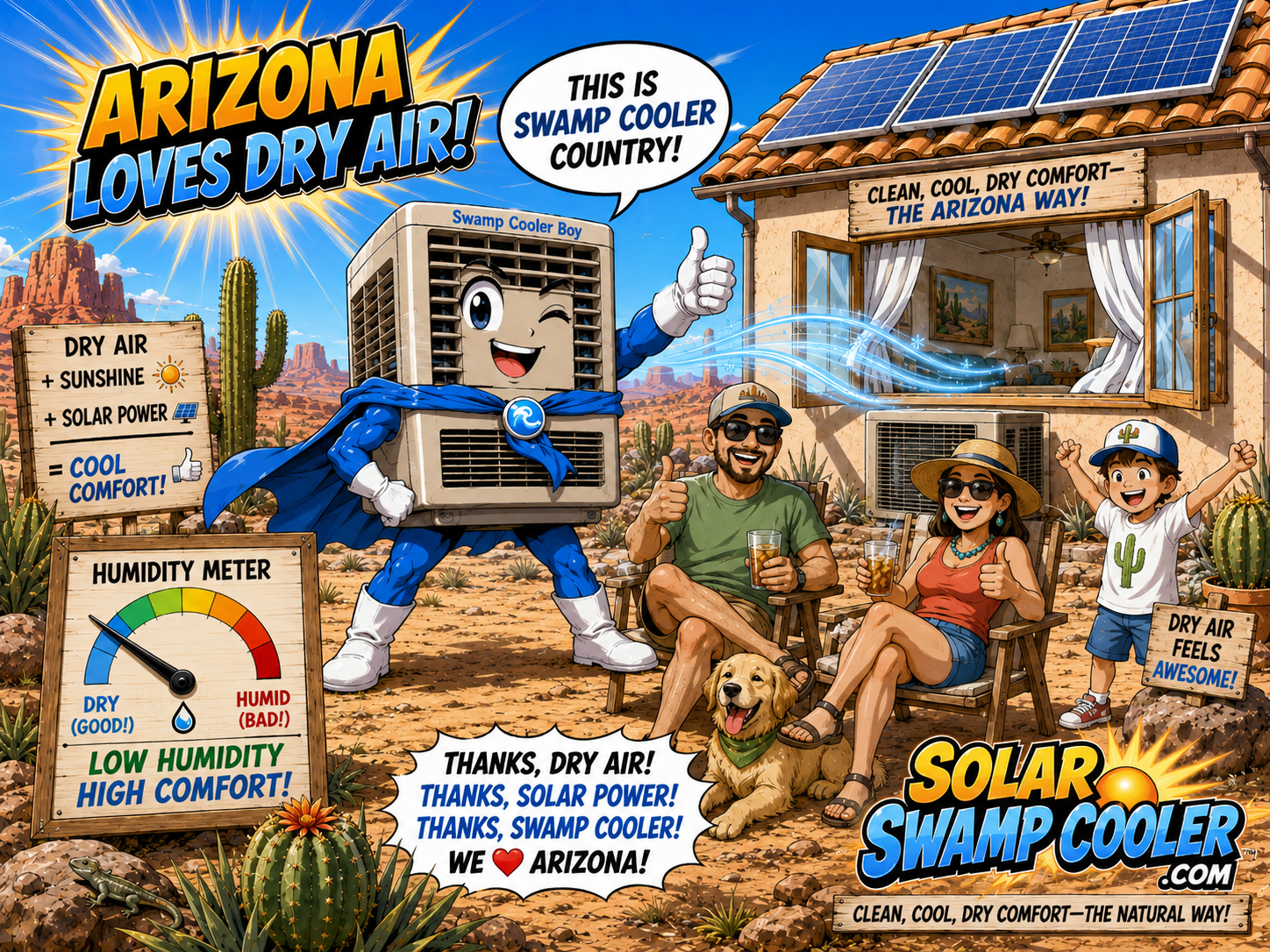
Arizona dry air success with swamp cooler, solar panels, and happy homeowners.

Green zone lesson

Dry places give the cooler a fighting chance.

The green zone is where Swamp Cooler Boy can shine: dry air, hot sun, open-window operation, clean pads, and real homeowner expectations.

  • Low humidity helps evaporation.
  • Dry heat favors the water-pad cooling trick.
  • Solar daytime production can match cooling hours.
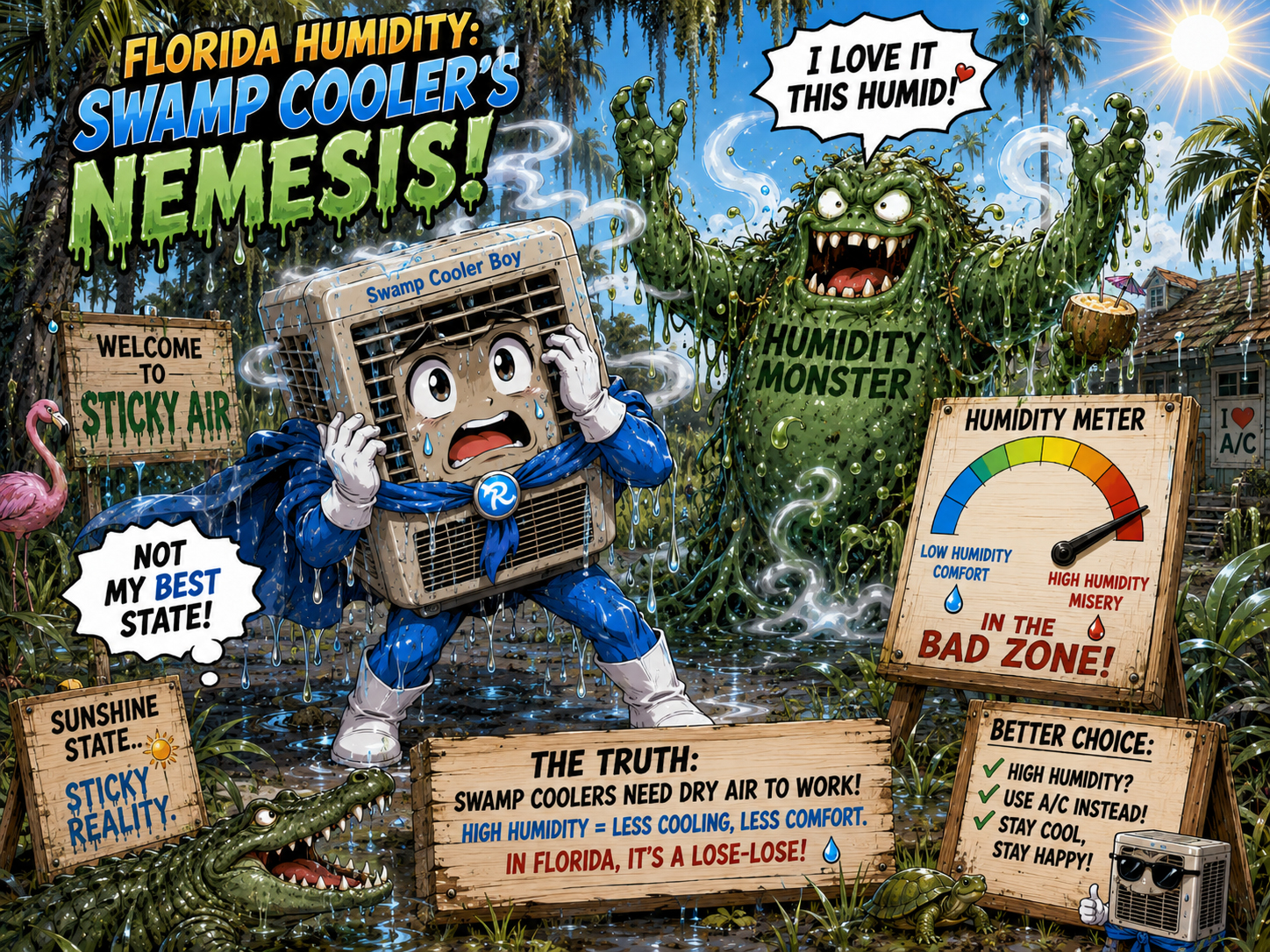
Florida humidity comedy warning where swamp coolers struggle.

Red zone lesson

Sticky places should be treated with caution.

The red zone is where humid air steals the punchline. Evaporation slows, cooling drops, and a swamp cooler can become a damp disappointment.

  • High humidity reduces evaporation.
  • Added moisture can hurt comfort.
  • Compressor AC may be the better tool.

The legend of the map

Green means shine. Yellow means investigate. Red means stay humble.

Episode 8 gives the homeowner a simple first filter. It does not replace local data or professional design, but it stops the biggest mistake: ignoring humidity completely.

Green: Shine

Dry low-humidity regions where evaporative cooling can work well with correct sizing, airflow, water quality, and maintenance.

Arizona New Mexico Nevada Utah High desert

Yellow: Struggle / Depends

Mixed or seasonal regions where performance may change with humidity, elevation, weather, shade, ventilation, and homeowner expectations.

Check data Seasonal Local design

Red: Stay Home

Humid regions where the air is often already moisture-heavy and evaporative cooling is usually a poor primary comfort tool.

Florida Gulf Coast Humid Southeast
SolarSwampCooler.com map of best, maybe, and poor climate zones.

The practical takeaway

The map starts the conversation. It does not finish it.

A funny map is a powerful memory tool, but a real cooling decision still needs local conditions. One town can be drier than another. Elevation matters. Monsoon seasons matter. Coastal fog matters. Homeowner expectations matter.

The map’s job is to keep the main rule alive: do not put Swamp Cooler Boy where Humidity Monster already owns the air.

Dry air helps Local data matters Sticky air hurts

Episode 8 punchline

The cooler found his destiny on a weather map.

Swamp Cooler Boy finally understands: the best sales pitch is not “works everywhere.” The best sales pitch is “works where the air is right.”

This episode is educational and comedic. It is not HVAC, electrical, solar, plumbing, health, or building-design advice. Actual performance depends on local humidity, temperature, elevation, season, airflow, sizing, pad condition, water quality, installation, operation, and maintenance.