Episode 6

The Compressor Dragon

Traditional AC enters as the expensive but powerful rival. Swamp Cooler Boy learns that Compressor Dragon is not always the villain — sometimes he is the right beast for sticky air.

The rival appears

The ground shakes. The meter spins. The dragon lands.

After the sticky coastal failure, Swamp Cooler Boy is still embarrassed. He tried to save a humid house, but Humidity Monster laughed him right off the porch.

Then the sky darkens. Coils flash. Ducts flap like wings. A giant machine-dragon lands beside the house, humming with compressor power.

“I am Compressor Dragon,” he says. “I am expensive. I am loud when neglected. I eat electricity for breakfast. But in humid air, I know what I am doing.”

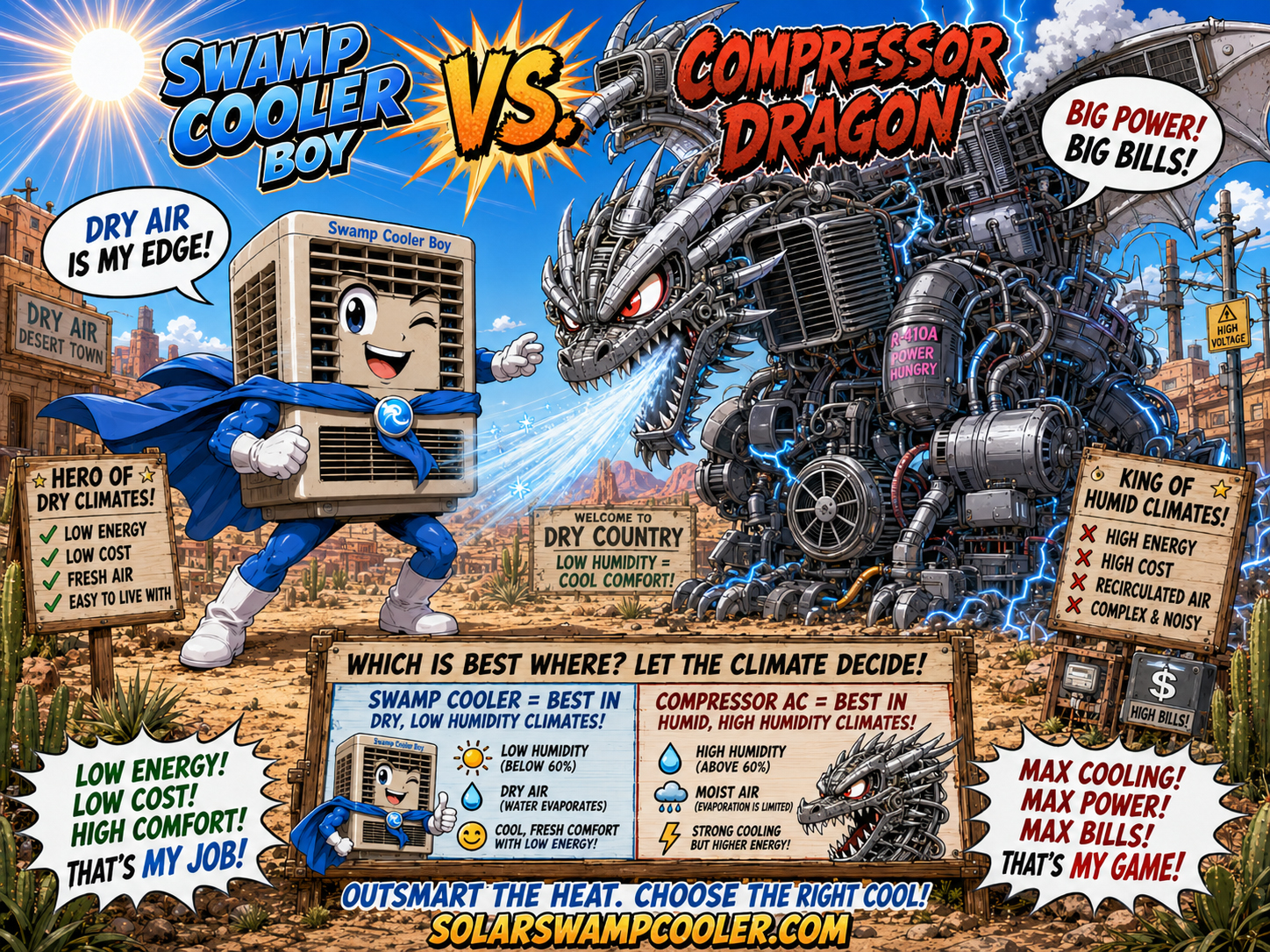
Compressor Dragon enters as the powerful AC rival to Swamp Cooler Boy.

Scene 1

Swamp Cooler Boy meets the rival.

Swamp Cooler Boy stands in the driveway with his cape damp from the humidity battle. Compressor Dragon towers over him, covered in coils, vents, refrigerant lines, and warning labels.

Swamp Cooler Boy: “So you are the famous traditional AC?”
Compressor Dragon: “Traditional? I prefer ‘refrigerated beast of controlled indoor comfort.’”
Swamp Cooler Boy: “You look expensive.”
Compressor Dragon: “I am. But sometimes expensive is still less painful than pretending a wet breeze can defeat a swamp.”

Scene 2

The dragon explains his power.

Compressor Dragon opens one wing and reveals the refrigeration cycle: indoor coil, outdoor coil, compressor, refrigerant lines, and a heroic amount of service complexity.

Compressor Dragon: “You need dry air. I do not. I move heat with refrigeration.”
Swamp Cooler Boy: “So you can work in humid climates?”
Compressor Dragon: “Yes. Sticky air is not my favorite breakfast, but I can fight it.”
Dry Air Sensei: “Remember, young cooler: different physics, different battlefield.”

Scene 3

The bill arrives with smoke effects.

Compressor Dragon cools the humid house. The homeowners cheer. Then the electric meter starts spinning like a manga tornado.

Solar Fan Kid: “Whoa. That is a bigger load than my fan-and-pump team.”
Compressor Dragon: “Powerful tools often have powerful appetites.”
Desert Grandma: “In dry country, I’ll take my swamp cooler and cracked windows. In sticky country, I’ll let the dragon work.”
Swamp Cooler Boy: “So the question is not who is better. It is who belongs here.”

Scene 4

The rivalry becomes respect.

Swamp Cooler Boy expected a villain. Instead he found a rival with a purpose. Compressor Dragon expected a toy. Instead he found a dry-climate specialist.

Compressor Dragon: “In Arizona dry air, you may be the elegant solution.”
Swamp Cooler Boy: “In Florida humidity, you may be the necessary beast.”
Dry Air Sensei: “Wisdom begins when tools stop pretending to be universal.”
Desert Grandma: “That’s nice. Now somebody clean the filter.”
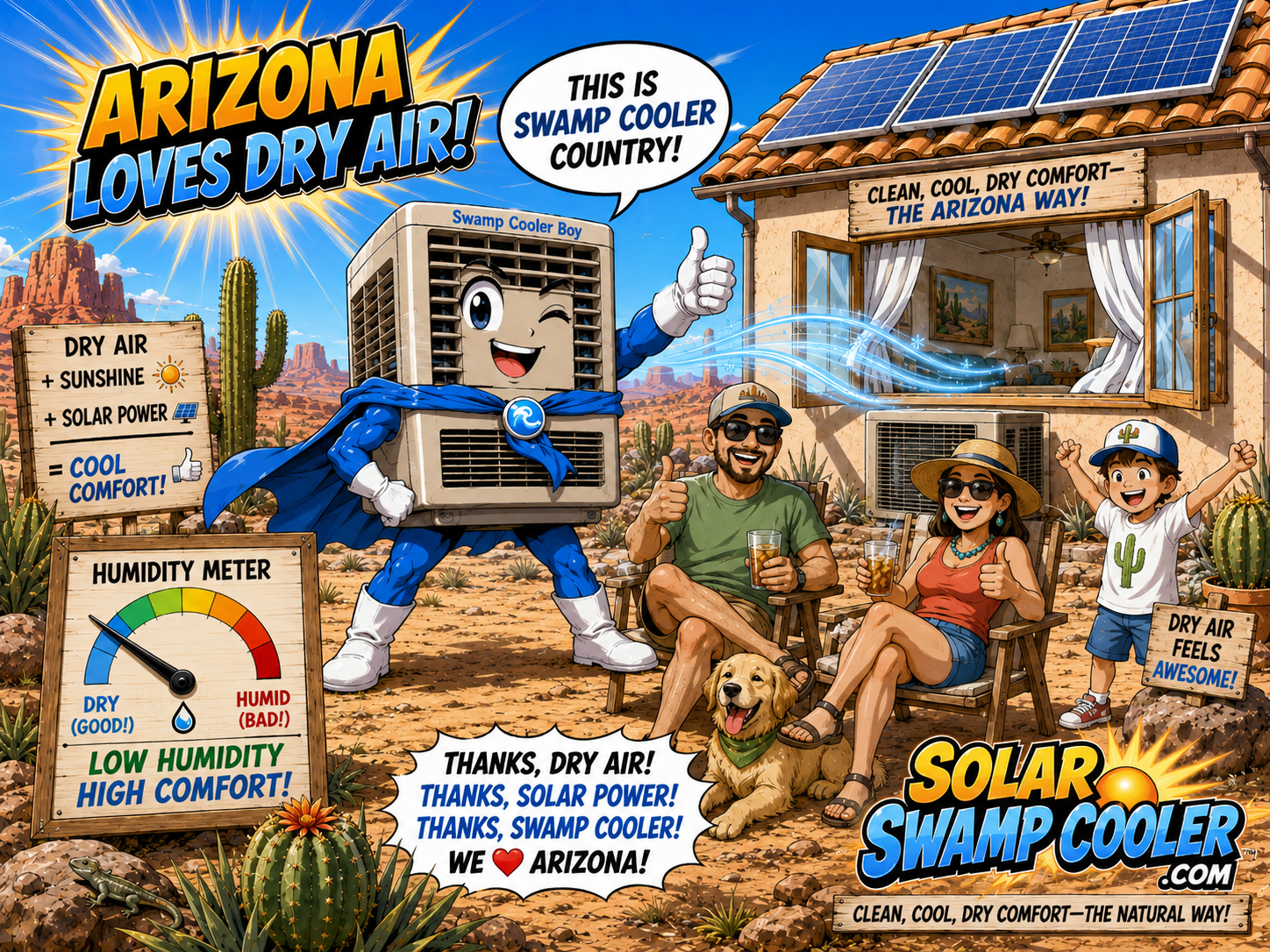
Swamp Cooler Boy succeeding in Arizona dry air.

Swamp Cooler Boy’s territory

Dry air gives evaporation the advantage.

In hot dry climates, evaporative cooling can be simple, fresh, and solar-friendly. The fan and pump have a very different power story than a compressor system.

  • Best in low humidity.
  • Needs open airflow through the house.
  • Uses water and pad maintenance instead of refrigeration.
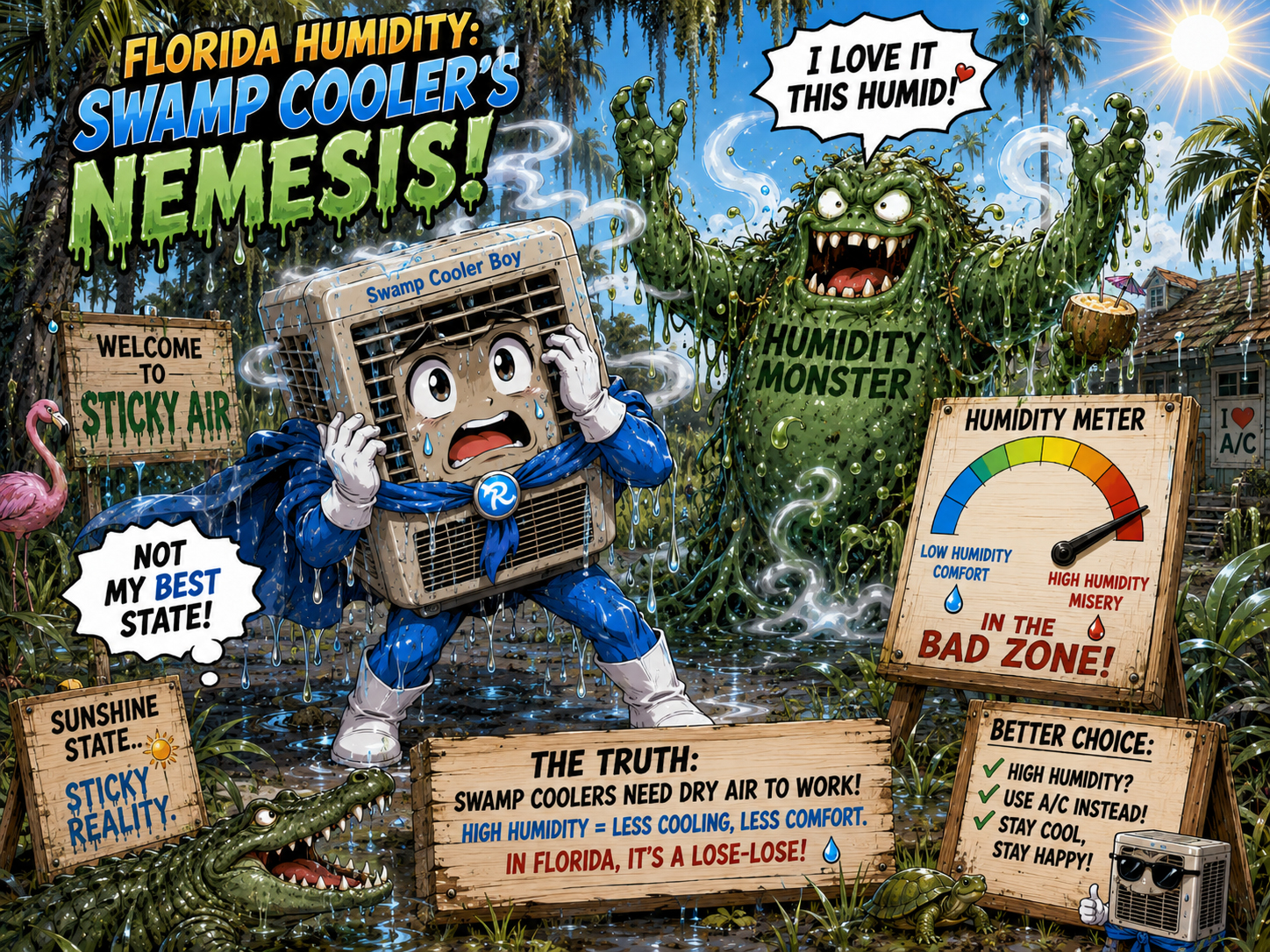
Humidity Monster winning in a sticky climate where AC may be better.

Compressor Dragon’s territory

Humid air needs heavier equipment.

In sticky climates, compressor AC often wins because evaporative cooling has little room to work. The dragon may be expensive, but he can fight the right battle.

  • Better suited for humid climates.
  • Can support sealed-window cooling expectations.
  • Often brings larger electrical loads and service complexity.

The comparison lesson

Two machines. Two physics stories.

Episode 6 is the maturity episode. It refuses the fake argument that one machine wins everywhere. The real answer is climate, building, budget, comfort expectations, maintenance, and power strategy.

Question Swamp Cooler Boy Compressor Dragon
Best climate Hot, dry, low-humidity places. Humid, mixed, coastal, and sealed-comfort places.
Cooling method Evaporation through a wet pad. Refrigeration cycle with compressor and coils.
Airflow style Fresh air comes in and exits through open windows or vents. Indoor air is typically cooled in a more sealed system.
Power story Fan and pump loads can be a solar-friendly daytime story. Compressor loads can be larger and expensive during peak hours.
Maintenance villain Mold Goblin: pads, pans, water flow, scale, and drainage. Service Dragon: filters, coils, refrigerant circuit, condensate, ducts.
Worst mistake Using it in humid air or sealing the house like AC. Oversizing, ignoring service, poor ducts, and peak-cost blindness.
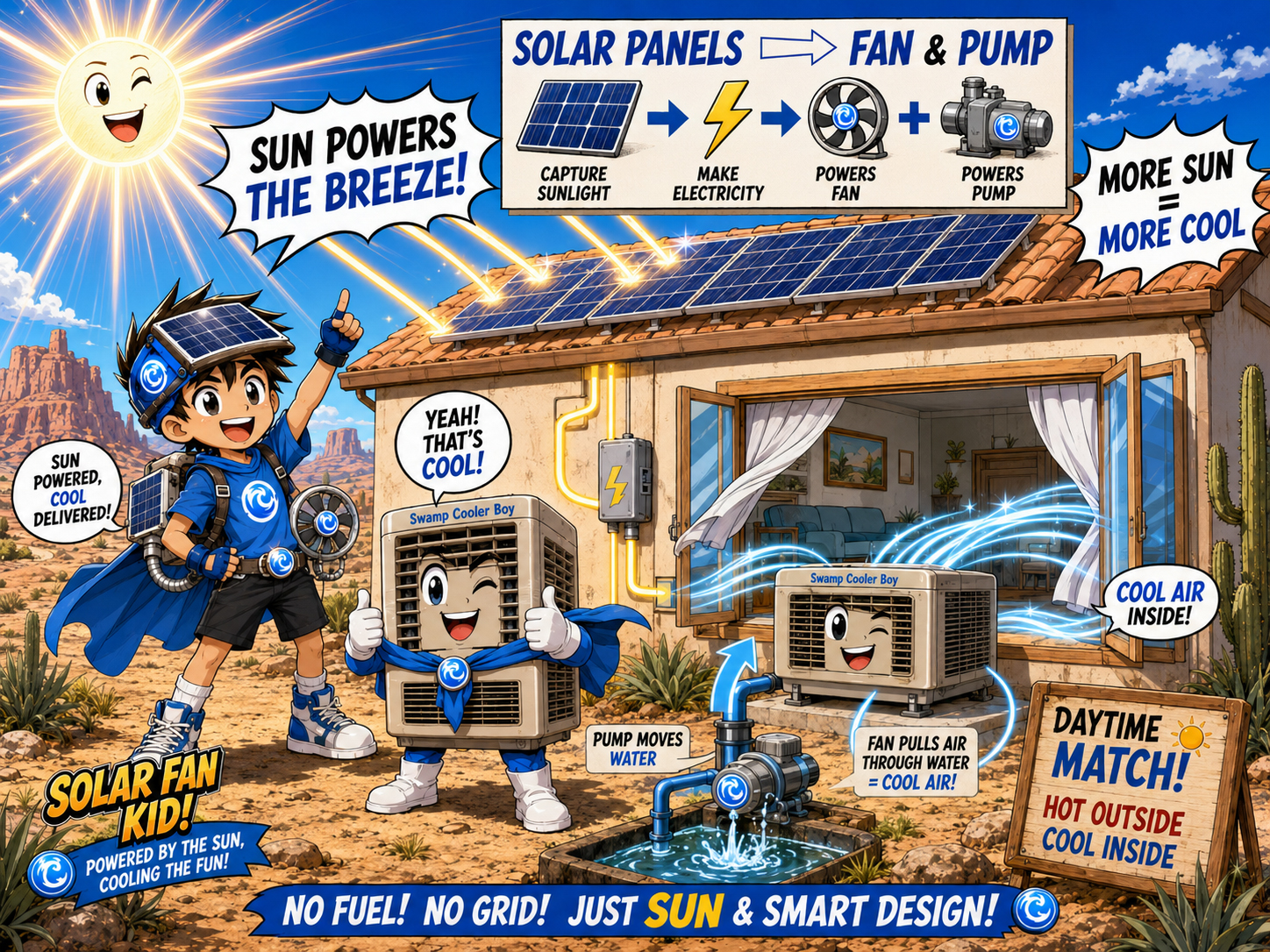
Solar panels powering a swamp cooler fan and pump.

Solar lesson

Solar helps both stories, but differently.

Solar Fan Kid can help offset energy use, but the load profile matters. A swamp cooler fan and pump are not the same kind of electrical beast as a compressor AC system.

In dry climates, solar plus evaporative cooling can be a clean daytime story. In humid climates, solar may support compressor AC instead — because humidity still decides the cooling tool.

Solar helps power Dry air helps swamp cooling Humidity still matters Load profile matters

Episode 6 punchline

The dragon was expensive, but he was not wrong.

Swamp Cooler Boy learns respect. Compressor Dragon learns humility. The homeowner learns the only lesson that matters: choose the cooling tool that matches the climate.

This episode is educational and comedic. It is not HVAC, electrical, solar, plumbing, health, or building-design advice. Cooling systems should be selected, sized, installed, wired, operated, and maintained according to manufacturer instructions, local codes, utility requirements, water quality conditions, and licensed professional guidance where required.